
Blog Archive
Exhausted but Can't Sleep
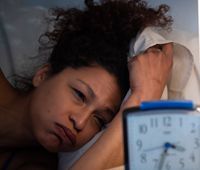
There are times when we are trying to go to sleep, but our minds continue race through the day's activities or what we need to do tomorrow. There are two methods to help you get some sleep, ones that are used by millions around the world that we want to tell you about.
We have all been there. After a long day (or week) you just want to go to bed. But once your head hits the pillow your brain kicks into high gear, either reviewing the previous day, organizing the next day, or just worrying about what is going to happen.
Stress is one of the leading causes of sleepless nights. But how do we overcome this obstacle to a good night's sleep?
Lucky for us, there are two methods that are proven to help those under high stress fall asleep quickly. The first one is used by the US Navy Seals and the second is called the military sleep method, was designed for military fighter pilots, but is used by countless other military personnel as well.
Claire Davis, a Certified Sleep Science Coach, explains the two methods in her articles," How to use the 4 7 8 sleep method to fall asleep fast and curb anxiety" and "This TikTok hack with 5.2 million views shows you how to fall asleep in 2 minutes." We will cover the basics and let you decide if either one is best for you.
Military Sleep Method
This method relies on muscular relaxation techniques, breathing exercises, and visualization. As with anything, it takes practice. The more you practice the easier you should fall asleep. Don't be discouraged if this doesn't work quickly the first time. The author states that after about six weeks of practice, approximately 96% found the method effective.
The 4 7 8 Sleep Method
In Clair Davies' second article, she shares a sleep method that she claims is even easier to use than the military sleep method. The 4 7 8 sleep method was developed by Dr. Andrew Weil, Founder and Director of the University of Arizona Center for Integrative Medicine. Dr. Weil states that it activates the (be careful of science) parasympathetic nervous system (PSNS), the system responsible for sleep and relaxation (relax now, sciency stuff is over.) The 4 7 8 sleep method relies on deep, rhythmic breathing.
This method is supported by research as a way to combat insomnia (See "Self-Regulation of Breathing as an Adjunctive Treatment of Insomnia" in Frontiers in Psychology) and stress (See "Feeling anxious? Try this breathing technique" from the University of Michigan Health).
Final Thoughts
You can also follow our guidelines in Setting a Child's Sleep Schedule and Sleep Insufficiency Among Teens where we help you set sleep schedules and prepare yourself and your bedroom for a good night sleep. By combining the techniques from this blog with the sleep preparation from the other blogs, you should be able to increase your chances of a more restful night.
Stress is one of the leading causes of sleepless nights. But how do we overcome this obstacle to a good night's sleep?
Lucky for us, there are two methods that are proven to help those under high stress fall asleep quickly. The first one is used by the US Navy Seals and the second is called the military sleep method, was designed for military fighter pilots, but is used by countless other military personnel as well.
Claire Davis, a Certified Sleep Science Coach, explains the two methods in her articles," How to use the 4 7 8 sleep method to fall asleep fast and curb anxiety" and "This TikTok hack with 5.2 million views shows you how to fall asleep in 2 minutes." We will cover the basics and let you decide if either one is best for you.
Military Sleep Method
This method relies on muscular relaxation techniques, breathing exercises, and visualization. As with anything, it takes practice. The more you practice the easier you should fall asleep. Don't be discouraged if this doesn't work quickly the first time. The author states that after about six weeks of practice, approximately 96% found the method effective.
- Relax all your facial muscles, including your jaw and tongue.
- Work your way down to your shoulders, dropping your them as far as you can, to the point where you can feel the tension melt away.
- Next, loosen your arms, hands and fingers. Don't sleep with your hands making a fist.
- As you now take deep breaths, your chest should start to relax.
- Follow this relaxation down to your legs, feet, and finally toes.
- As you reach do this, envision a warm, relaxing feeling flowing over your body from the top of your head to the tip of your toes.
- Deeply inhale and exhale, freeing your mind of thoughts and stress.
- Finally, think about lying somewhere calm, such as a canoe or a hammock.
The 4 7 8 Sleep Method
In Clair Davies' second article, she shares a sleep method that she claims is even easier to use than the military sleep method. The 4 7 8 sleep method was developed by Dr. Andrew Weil, Founder and Director of the University of Arizona Center for Integrative Medicine. Dr. Weil states that it activates the (be careful of science) parasympathetic nervous system (PSNS), the system responsible for sleep and relaxation (relax now, sciency stuff is over.) The 4 7 8 sleep method relies on deep, rhythmic breathing.
- Find a comfortable position where your body can relax
- Place the tip of the tongue against the gums behind the front, upper teeth
- Exhale through your mouth, making a whooshing sound.
- Inhale through your nose for 4 seconds (keep your mouth closed).
- Hold your breath for 7 seconds (one Mississippi, two Mississippi, etc)
- Exhale though your mouth for 8 seconds, again making the whooshing sound.
- That is the end of the breathing cycle.
- Repeat steps 1 - 7, three to four time, twice a day
This method is supported by research as a way to combat insomnia (See "Self-Regulation of Breathing as an Adjunctive Treatment of Insomnia" in Frontiers in Psychology) and stress (See "Feeling anxious? Try this breathing technique" from the University of Michigan Health).
Final Thoughts
You can also follow our guidelines in Setting a Child's Sleep Schedule and Sleep Insufficiency Among Teens where we help you set sleep schedules and prepare yourself and your bedroom for a good night sleep. By combining the techniques from this blog with the sleep preparation from the other blogs, you should be able to increase your chances of a more restful night.